

Advocacy in Case Management at the End of Life
BY , PhD, RN, FAAN, FCM
Advocacy is a defining function of professional case management. It assumes heightened importance at the end of life, when patients and families must navigate complex decisions, emotional distress, and fragmented care systems. Strengthening advocacy capacity among professional case managers is essential to promoting patients’ dignity, reducing non-beneficial interventions, and ensuring equitable access to palliative and hospice services. This article briefly examines advocacy in end-of-life case management through ethical, clinical, and systems perspectives.
Advocacy has long been recognized as a core standard of case management practice. However, its application at the end of life requires a nuanced understanding of ethical principles, communication dynamics, and systemic constraints. Unlike earlier phases of care that emphasize patients’ recovery or stabilization, end-of-life care prioritizes comfort, dignity, equity, and quality of life. Professional case managers must therefore balance clinical realities with individual goals, ensuring that decision-making processes are informed, culturally responsive, person-centered, and ethically grounded.
Despite growing recognition of the importance of palliative and hospice care and advance care planning, many patients continue to receive treatments inconsistent with their goals and preferences. Fragmented communication, late hospice referrals, and disparities in access remain persistent challenges. Advocacy by case managers is a critical mechanism for addressing these gaps, serving as a bridge between patients, families, personal caregivers, clinicians, and healthcare organizations, including payers.
DEFINING ADVOCACY IN END-OF-LIFE CASE MANAGEMENT
The final phase of life represents one of the most vulnerable periods in a patient’s healthcare trajectory. Those with serious illnesses often experience escalating symptom burden, prognostic uncertainty, and repeated transitions across healthcare settings and diverse health and social care providers. Families and personal caregivers simultaneously assume caregiving responsibilities while grappling with emotional, ethical, financial, and other practical challenges. In this context, professional case managers play a pivotal role in ensuring that care remains aligned with patients’ values, goals, culture, and preferences while supporting them in navigating complex healthcare systems and offering emotional and psychosocial support.
Advocacy in end-of-life case management is the intentional actions taken to protect patient rights, autonomy, and self-determination, ensure informed decision-making, and address barriers to appropriate care. At the end of life, advocacy extends beyond individual interactions to encompass coordination of services and resources across systems and practice settings, with special attention to patients’ social determinants of health and their related social care needs.
ETHICAL UNDERPINNINGS
Ethical principles relevant to end-of-life care anchor advocacy practice and guide professional case managers in balancing clinical realities with individual values, particularly when treatment options may prolong a patient’s life without improving its quality. Professional case managers facilitate advance care planning and ensure that the treatment decisions patients and their families make reflect informed consent. Case managers apply the five main ethical principles in their practice and when caring for patients and families at the end of life. Like in other care situations, these principles provide the moral foundation for advocacy. In successfully doing so, case managers adhere to the standards of practice promulgated by the Case Management Society of America (CMSA), especially the standard on advocacy (CMSA, 2022).
- Autonomy entails respecting patient independence and right to choice. It involves honoring a patient’s preferences regarding treatment intensity, location of care, duration of treatment, and quality-of-life priorities.
- Beneficence seeks to promote a patient’s comfort, quality of life, and well-being.
- Non-maleficence is avoiding interventions that may prolong suffering without meaningful and measurable benefit.
- Justice ensures patients’ equitable access to hospice and/or palliative care, and supportive services which are central to advocacy, particularly in addressing disparities affecting marginalized populations.
- Veracity is being honest, truthful, and accurate with the patient and family by telling the truth about condition, prognosis, and expected treatment outcomes.
End-of-life decision-making occurs within networks of relationships. Professional case managers attend to family dynamics, cultural contexts, and emotional experiences, recognizing that ethical care is relational rather than purely individual. Advocacy in this context operates at multiple levels: clinical, relational, and system. This multi-level perspective underscores the role of case managers as both patient representatives and systems navigators. Clinically, advocacy ensues in the form of supporting patient’s decision-making and desire for symptom management rather than intensive and curative treatment. Relationally, advocacy fosters communication and trust among the patient, family, personal caregiver, and members of the health care team. At a system level, advocacy addresses structural barriers to care and mitigates service and resource gaps.
CASE MANAGEMENT ADVOCACY EFFORTS AT THE END-OF-LIFE
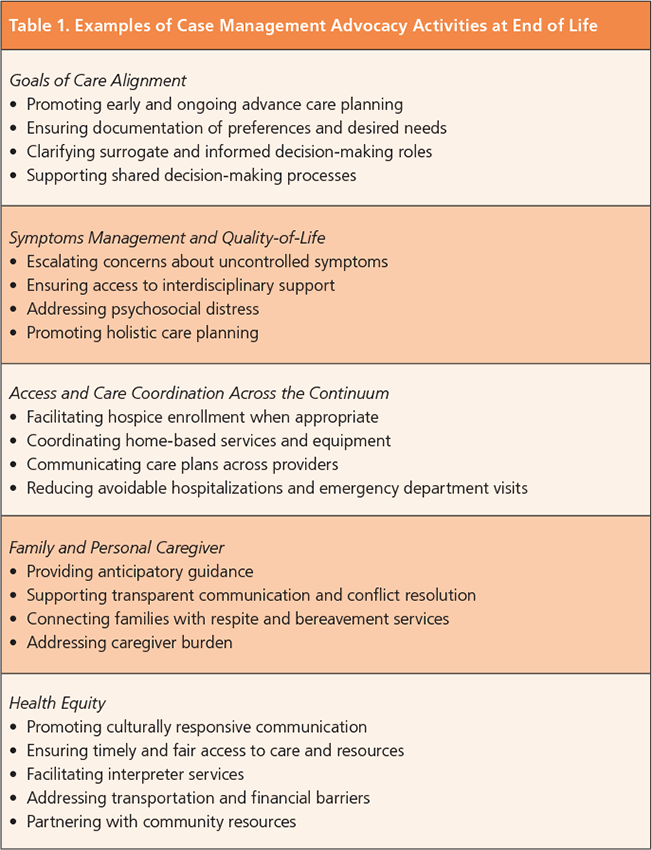
Professional case managers engage in advocacy activities at the end-of-life phase of a patient’s illness. These activities can be clustered into five categories as follows. Key examples are listed in Table 1.
1. Goals-of-Care Alignment
One of the most critical advocacy functions involves aligning treatment plans with patients’ values and what matters most to them. Professional case managers facilitate discussions about advance care planning, prognosis, treatment options, and likely outcomes, often coordinating family meetings and interdisciplinary consultations. These activities help prevent unwanted aggressive care, support informed decision-making, and enhance the likelihood of goal-concordant treatment.
2. Symptoms Management and Quality-of-Life Advocacy
As illness progresses, the focus of care shifts toward comfort and quality of life. Professional case managers advocate for comprehensive symptom assessment, management, and timely palliative care involvement. They monitor whether care plans address physical, emotional, social, cultural, and spiritual needs. By emphasizing comfort and dignity, case managers help patients maintain a sense of control and meaning during the serious illness phase.
3. Care Coordination Across the Continuum
Transitions between care settings are particularly vulnerable periods for patients and their families at the end of life. Advocacy involves ensuring continuity of care, including timely referrals, medication reconciliation, durable medical equipment, and coordination of services. These activities enhance patient safety, support care in the preferred setting, and promote patient, family and caregiver confidence.
4. Family and Caregiver Advocacy
Families are often integral to care delivery yet may feel unprepared for their roles. They may experience moral distress, uncertainty, and anticipatory grief. Case managers provide education and emotional support, mediate conflicts, and connect caregivers with community resources, recognizing caregivers as partners in care. Supporting caregivers not only improves their well-being but also contributes to better patient outcomes.
5. Health Equity Advocacy
Significant disparities exist in end-of-life care utilization and experiences. Cultural beliefs, language barriers, socioeconomic constraints, and systemic inequities influence patient and family’s access to supportive services. Case managers advocate for culturally responsive communication and policies that address structural barriers. These efforts for equity-focused advocacy ensure that all patients receive care consistent with their values.
EFFECTIVE CASE MANAGEMENT ADVOCACY
Effective case management advocacy at the end of life requires a sophisticated skill set integrating clinical knowledge, communication expertise, and ethical, legal, and systems awareness. Clinically, professional case managers must understand disease trajectories and prognostic indicators. They also must possess relevant knowledge of palliative and hospice care principles. In the area of communication, case managers must be comfortable conducting serious illness conversations with patients and their families while navigating emotional responses and facilitating optimal shared decision-making. From an ethical and legal perspective, case managers should demonstrate ability to initiate and interpret advance directives plans, understanding of surrogate decision-making laws, and recognizing decisional capacity issues. As for systems awareness, case managers should successfully navigate reimbursement and regulatory frameworks while coordinating interdisciplinary care teams and addressing social determinants of health concerns.
CONCLUSION
Successful professional case managers’ efforts in patient and family advocacy at the end of life contribute to improved alignment between care received and patient preferences, enhanced symptom control, and greater perceptions of dignity and respect. Patients receiving advocacy-driven care are more likely to access hospice services and less likely to undergo non-beneficial interventions. Ultimately, patients receive care and services of their choice while families benefit from improved communication, reduced decisional regret, and better bereavement experiences. Clear guidance and coordinated care by case managers reduce the patients’ and families’ experience of uncertainty and emotional burden. From a systems perspective however, advocacy supports value-based care by reducing avoidable patients’ hospitalizations, shortening lengths of stay, and promoting appropriate and timely utilization of palliative services. These outcomes align with broader healthcare goals of improving quality while controlling costs. These also underscore the optimal impact of the advanced practice nature of end-of-life case management advocacy.
REFERENCE
Case Management Society of America (CMSA). (2022). Standards Of Practice for Case Management. Brentwood, TN: Author.
 Hussein M. Tahan, PhD, RN, FAAN, FCM, is a case management expert, consultant, author, professional speaker, and scientist. Hussein is widely published, a co-editor of the CMSA’s core curriculum for case management, member of the CMSA today editorial board and advisory board member of the professional case management journal. Hussein is the recipient of the 2016 CMSA lifetime achievement award and the 2025 national service excellence award.