
Optimizing Hospital Throughput Using Direct Bill Skilled Nursing Facility Partnerships: A Three-Year Review of the OhioHealth-Laurels Healthcare Model
BY , BSN, RN, MSOL, CCM, AND
EXECUTIVE SUMMARY
In early 2023, OhioHealth and The Laurels Healthcare launched a direct-bill, contracted-bed model to safely transition medically stable, long-stay patients with significant discharge barriers from acute care to skilled nursing facilities (SNFs). Over three years, the partnership improved hospital throughput, protected inpatient capacity, and aligned costs with the appropriate level of care. This story synthesizes program design, roles, operational learnings, and outcomes, and it highlights opportunities to scale the model across the system.
A SYSTEM CHALLENGE: PATIENT READY FOR DISCHARGE
Prior to the program, OhioHealth Grant Medical Center experienced a high volume of patients with length of stays up to 1.5 years. Across hospital systems, persistent throughput challenge involves patients who are medically ready for discharge, but cannot transition safely due to complex social, financial or legal barriers. These include uninsured or underinsured individuals, patients without safe housing options, behavioral health or psychosocial complexities, and high acuity needs not supported by traditional post-acute providers. Initially an inpatient unit was converted to a Long Stay Unit to house these patients.
The average daily rate for these patients was $800/day, without any reimbursement. Typically the census on the long stay unit was on average 20 patients.
There was also concern for the patients who often lingered on the unit, which impacted throughput and was not the appropriate setting to meet the long term care needs of the patient. The nursing team was switched to an all LPN model to offset the cost of care.
The system process at that time was to review these cases at the System Complex Case review team. This multidisciplinary team consisted of care management, legal, ethics, and patient finance. Cases were presented for discussion and brainstorming on potential discharge options. Through this group it was discussed that another solution needed to be created to discharge patients.
Members of the CM team selected 3 potential partners to assess for capacity, service and experience in bed contracting. The Laurels were selected because they had started some bed contracting with other hospitals on a smaller scale. We also recommended the Laurels due to their large capacity of beds that mirrored the OhioHealth footprint in central Ohio and the region.
THE DIRECT BILL CONTRACT MODEL
Once the Laurels were selected, the legal teams for each entity completed the contract, including multi-tiered rates based on level of care.
Under this model, OhioHealth pays the Laurels a contracted per diem rate for each patient placed, bypassing traditional payer requirements. This structure enables the SNF to accept higher acuity cases, undocumented patients, long stay custodial individuals, or ventilator or clinically complex patients. Each potential admission undergoes a comprehensive clinical and psychosocial review, daily rate negotiation based upon acuity and needs, final approvals by a Laurels regional leader and ongoing care management by designated SNF hospital liaison, with regional oversight. This ensures clinical appropriateness and transparent financial alignment. The Laurels accepts complex individuals who would otherwise remain in hospital beds, often beyond DRG reimbursement windows.
HOW THE MODEL WORKS
Key roles and processes include:
- Acute care management associate presents the case to the system complex review team where the recommendation for a contract bed may be determined.
- SNF Dedicated hospital liaison to coordinate daily with case managers and complete bedside assessments. Point person for communication between hospital and SNF and families
- SNF Regional leadership oversight to provide ongoing updates to hospital via email and weekly meetings.
- Structured clinical and financial review of each referral; final approval before admission on both hospital and SNF sides.
- Transparent, equitable rate-setting for skilled, custodial, ventilator, and clinically complex cases.
PROGRAM GROWTH AND IMPACT (2023-2026)
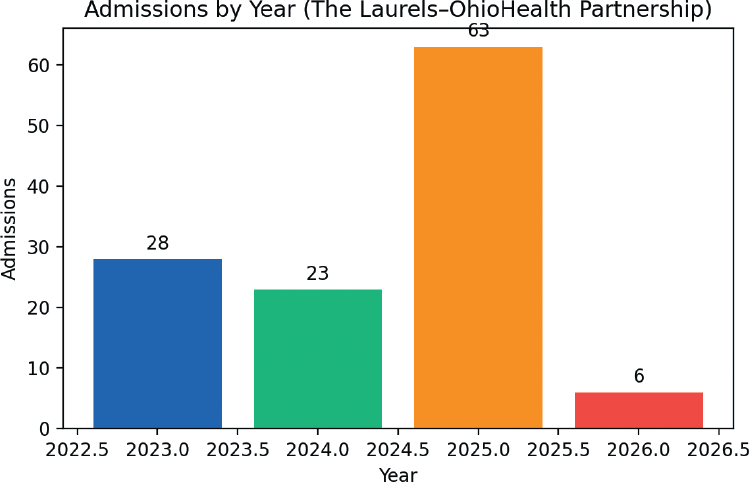
The partnership has grown in both scale and sophistication since implementation. Admission volume over time shows clear expansion, with a pronounced increase in 2025 as hospitals leveraged the program for complex placements.
Contract admissions primarily originated at Grant Medical Center, with additional referrals from other OhioHealth hospitals:
WHO WE SERVED
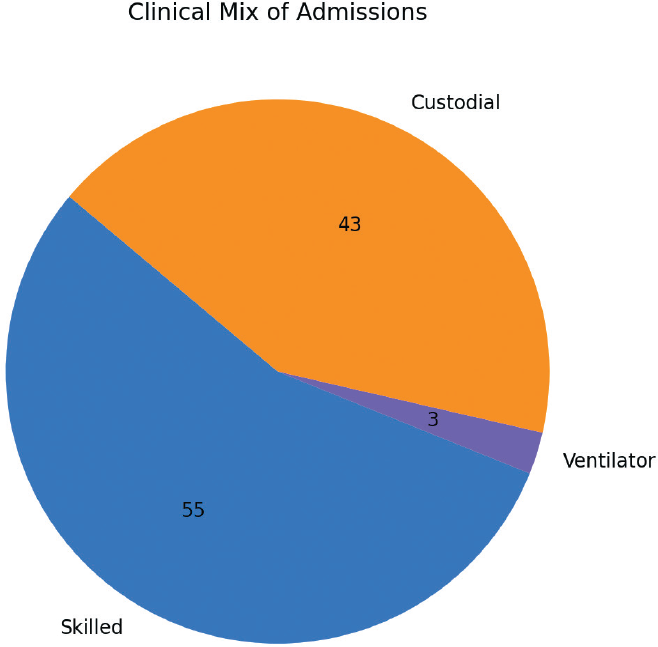
The partnership supported a high-acuity population with diverse needs:
- Total admissions: 120
- Discharges completed: 84
- Active patients: 36
- Undocumented patients: 31
- Anticipated long-term care (subset of undocumented): 9
Length of Stay (LOS)
- Average LOS (days): 127.3
- Median LOS (days): 59.5
- Middle 50% LOS (days): 26.75–136
- Active caseload LOS avg (days): 118
Patients placed under this model are consistently more complex than typical SNF admissions.
The long stay nature underscores the necessity of a contract model as traditional SNF reimbursement would not support this population.
FINANCIAL IMPACT AT GRANT MEDICAL CENTER
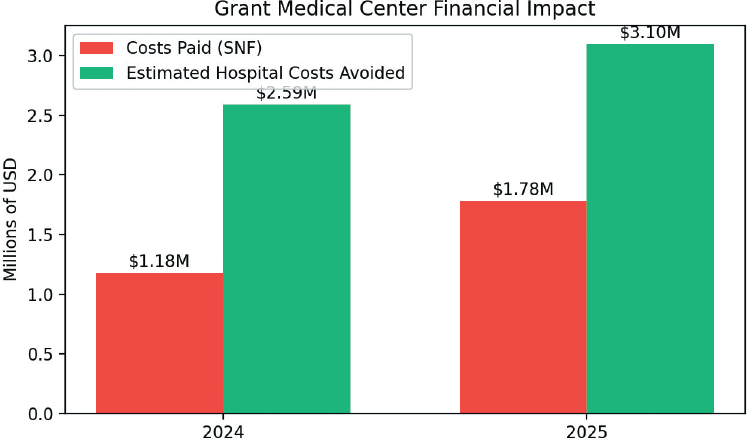
Relative to estimated hospital costs avoided, the direct SNF spend remained favorable:
FINANCIAL AND CLINICAL VALUE PROPOSITION
Hospital Perspective. At Grant Medical Center, the program avoided an estimated $2.59 million in hospital costs in 2024 and $3.1 million in 2025, with average per diem costs between $347-$549- well below acute care costs. Refunds in 2024, totaled $170,000 for patients whom Medicaid was eventually established while under contract.
SNF Perspective. The direct bill contract afforded The Laurels a unique opportunity to assist in managing the hospital’s complex, long-stay patients. The partnership allowed for SNF organization to develop strong lines of communication with hospital case management, which allowed for other innovative discussion about barriers or programs to meet the needs of underserved patients. It allowed for SNF facilities to stabilize census with a lower financial risk than would normally be associated with this patient population.
Increase in patient census for Laurels skilled nursing facilities, allowing a more consistent, stable daily census to streamline staffing and improve quality of care.
Ability to grow experience, work through challenges and potentially offer this program to other hospital systems in need outside of the Columbus, OH market.
A PATIENT JOURNEY (COMPOSITE CASE)
A middle-aged patient with multi-morbidity and complex social barriers remained inpatient beyond 20 days awaiting placement. Through the contract-bed pathway, The Laurels completed a bedside assessment, accepted the referral at an agreed daily rate, and initiated therapy and stabilization. Within eight weeks, the patient achieved functional milestones and secured durable medical equipment through charity support, enabling discharge to a community setting with home health.
In February 2023, an undocumented male with severe traumatic injuries admitted to The Laurels. SNF staff provided ongoing ventilator weaning and physical therapy while working to locate family in Mexico. Over time, the patient made remarkable progress, reaching a point where he could travel on a commercial flight with his family. To support his journey, OhioHealth assisted with purchasing a specialized wheelchair for the plane. In May 2024, the young man was able to reunite with his family and return home.
In August 2025 a gentleman was found unresponsive, admitted to the hospital where he was treated for severe infections for almost 30 days. He was admitted to Laurels in September 2025 for in-house Hemodialysis and physical, occupational, and speech therapies. He was able to rehabilitate almost fully and with coordination with his wife and children in Mexico he returned to his home country in February 2026.
LESSONS LEARNED AND ENABLERS
- Speed-to-decision: a clear approval path reduces avoidable bed days.
- Shared visibility: a single source of truth for census, LOS, and barriers keeps teams aligned.
- Defined escalation for charity DME/home health funding accelerates safe discharge.
- No preset LOS: clinical readiness, not the calendar, determines next site of care.
A SCALABLE REPLICABLE MODEL
The OhioHealth-Laurels partnership demonstrates that direct bill contracts can improve hospital throughput, better serve complex, high-risk individuals, stabilize SNF operations, reduce system-level costs, and enhance continuity and quality of care. As demand for innovative post-acute solutions grows, this model offers a proven blueprint for health systems seeking to expand care pathways for medically stable but hard-to place patients,
RECOMMENDATIONS AND NEXT STEPS
- Sustain and scale at Grant while lateralizing to campuses with similar case mix.
- Codify referral criteria and financial guardrails for clinically complex and custodial cases.
- Expand data automation to track throughput, LOS, avoidable bed days, and downstream utilization.
- Explore adjacent innovations (e.g., medical respite for unhoused patients) with shared governance.
CONCLUSION
The OhioHealth—Laurels direct bill skilled nursing facility (SNF) partnership has demonstrated a highly effective, sustainable solution for managing medically stable, hard-to-place patients who historically remained in acute care settings for extended periods. Over three years, the model has improved hospital throughput, protected inpatient capacity, and ensured that patients receive care in the most clinically appropriate environment.
By establishing clear processes for referral review, financial alignment, and clinical approval, the program enabled swift placement decisions and streamlined transitions of care. The partnership also strengthened communication between SNF and hospital care management teams, allowing both organizations to address complex social, financial, and clinical barriers more effectively.
The outcomes—including reduced acute-care costs, stabilization of SNF census, successful repatriations of international patients, improved functional recovery, and the ability to support ventilator, dialysis, and long-stay custodial individuals—underscore the value and necessity of innovative post-acute strategies.
As health systems continue to face rising patient complexity and capacity constraints, this direct bill contracting model offers a replicable blueprint for expanding safe discharge options, improving patient flow, and supporting vulnerable populations. Continued refinement of operational processes, data automation, and expansion to additional campuses will further enhance system-wide value, clinical outcomes, and sustainability.
 Amy Campbell-Tumblin, Regional Director of Business Development, Ciena/Laurels Healthcare, has pursued a career in healthcare for almost 20 years with a focus in post-acute care. She graduated from The Ohio State University in 2004 with a Bachelor of Science Degree in Consumer Affairs with a minor in Marketing. Her passion for health care was ignited when her grandmother was a patient in a local nursing home as she graduated from college. She has spent her career ensuring that patients and families have access to making informed decisions and finding quality care options to meet their needs.
She started her career in her hometown of Logan, OH working with Alzheimer’s patients and finding innovative techniques to manage behaviors and symptoms of the disease. She worked with families and facilitated family support groups for years. She then moved into the business development side of healthcare as the Director of Marketing at the same location. She worked in a community aspect to educate and share post-acute care options with seniors, physicians, and families in the area.
Amy now has worked in a regional capacity in the post-acute care industry for nearly 10 years. Providing oversight and support to multiple skilled nursing facilities throughout Ohio and Indiana. Her achievements are becoming an expert in business development strategy in many specialty care services, dialysis, behavioral health, substance abuse/addiction and ventilator/respiratory care. She also assists and oversees special projects such as the direct bill contract partnership with hospitals to provide innovative and strategic solutions for long stay patients and difficult to place patients.
She is married to a fellow health care warrior, Bill, who is a nurse, Army veteran and Licensed Nursing Home Administrator. They share 5 children, a beautiful 4-year old boy Parker as well as 4 step-children to create a harmoniously blended family.
 Jacqueline (Jacqui) Bastian, BSN, RN, MSOL, CCM, has been an RN for 38 years and a USAF veteran that served as an officer in the Nurse Corp during the first Gulf war. She joined OhioHealth in 2015 and is currently the Director of Care Management at OhioHealth-Grant Medical Center in Columbus Ohio. Grant is Ohio’s largest Level 1 trauma program in Ohio.
Jacqueline has 30 years’ experience in care management in the acute, ambulatory and managed care settings and is currently leading work in the system addressing social determinants of health.
Jacqui’s work in working with the underserved, undocumented and complex discharge dispositions resulted in her leading significant projects that resulted in opening the first Medical Respite in central Ohio in 2020 and a program to move patients to the right place and right level of care through bed contracting with a community partner in 2023.
She is the recipient of the Global Center for Education Honoree award from Franklin University for her contributions to the medical respite program.
Jacqui is also a Hudson certified coach who enjoys working with other professionals seeking to improve professionally and personally.
Jacqui’s most important job is being mom to her sons, Ethan (28) and Evan (25).
 Kate Coffield is a social worker with 30 years of experience in medical case management. She is currently the Manager of Care Management at Grant Medical Center in Columbus, Ohio, where she has gained extensive knowledge of complex discharge planning and leads a team of case managers invested in this work. She has assisted in the development and operations of the SNF Contract Bed and Medical Respite programs which have created discharge options for patients with challenging barriers. When she is not working, she enjoys time with family, going on walks with her dog, Daisy, and cheering for her favorite team from her alma mater, The Ohio State Buckeyes!